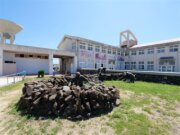
After five years of preparation, the Children's Art Education Center, funded by the TSMC Education and Culture Foundation and subsidized by the Taipei City Government, officially opened its doors on Children's Day in 2014 under the efforts of the museum staff and the architectural design team. The inaugural exhibition, titled "Gift," symbolized its mission: a gift for future generations. The visual identity design features geometric blocks stacked like building blocks, inspired by the pipe-like structural elements of the Taipei Fine Arts Museum; the window symbol represents children driven by small curiosities, peeking out from the corner of a window to explore a broader world. The Children's Art Education Center builds on existing spatial conditions, transforming peripheral spaces into operational cores and gradually incorporating contemporary art education concepts. In addition to emphasizing learning as a core value, since 2015, the center has aimed to expand the definition of education, creating new knowledge production methods and museum experiences. The traditional museum's collection and exhibition functions, centered on "objects," have gradually shifted to a people-centered approach. Museums not only house rich art collections but also serve as friendly spaces where audiences can relax, socialize, and experience art in daily life. Furthermore, they emphasize participatory experiences, aiming for audiences to learn through interactions and discussions with peers, sparking diverse possibilities for visitor experiences and developing new relationships between the museum and its audience. Contemporary art incorporates a wide range of interdisciplinary knowledge and emphasizes critical thinking and social engagement. In 2016, the educational projects of the Children's Art Education Center officially transitioned from exhibition concepts to "education programs," with one to two programs launched annually, combining thematic exhibitions and creative workshops planned jointly by museum educators and contemporary artists. In these "education programs," museum staff are not only intermediaries interpreting artworks but also transformers of experiences; the role of artists extends beyond being passive creators of works to actively becoming constructors of learning experiences. On one hand, the education programs use artists as models, allowing children to understand the world through the artists' perspectives, their creative thinking, and problem-solving methods. On the other hand, artists are invited to collaborate with museum staff to develop interactive installations for each education program, transforming experiences from their own works or those of other artists into learnable models, guiding audiences from passive visual appreciation to active participation through bodily and sensory engagement. Through participation in education programs, audiences become proactive explorers of the world, accumulating visual literacy and conceptual critical thinking skills. (Source: Children's Art Education Center)