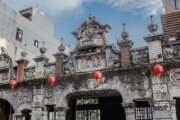
Yingge is known for its ceramics and is often called Taiwan’s Jingdezhen. More than two centuries ago, Wu An from Quanzhou in Fujian established a kiln in Tuzikeng in 1804 and later developed his business around Jianshanpu. Relatives who migrated from Quanzhou also took up pottery, helping a community of kiln workers take shape. The clay-rich local soil could be shaped into vessels, while firewood, coal and access to river transport helped the kilns grow. Ceramic production expanded during Japanese rule. Square chimneys surviving from the coal-fired era near Jianshanpu recall a time when kilns lined the streets.
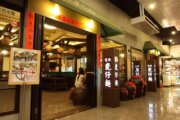
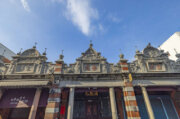
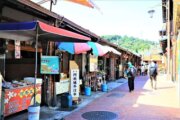
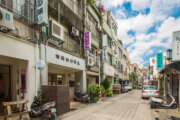
The district was officially named Ceramics Old Street in 2000. It centres on Taoci Street, Jianshanpu Road, Chongqing Street and Yuying Street. Former factories gradually became shops, studios and hands-on workshops. Ceramic installations at intersections, streetscape details and signs reflect the local trade. Long-established retailers, artists’ studios, exhibition shops and factory outlets display antique-style porcelain, crystalline-glazed pieces, tea sets, tableware and ceramic ocarinas. Some studios offer pottery-making classes.
Yingge Spot displays ceramics and other art, carrying on the district’s tradition of exhibiting and selling local craft. A railway footbridge near the old street looks out over the district and the trains passing along the Western Main Line.