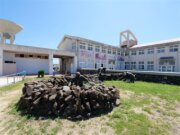
The establishment of the Huagang Museum was initiated at the time of the founding of Huagang University. The founder, Mr. Zhang Qiyun, on March 1, 1962 (Republic of China year 51), established the "Founding Purpose Book" with the motto "Higher Education (University), Academic Research (Graduate Institute), and Service Promotion (Enterprise) integrated as one," setting the direction for the school's establishment. Adhering to the principle of "equally emphasizing libraries and museums," the idea of establishing a museum was conceived.
The preparatory period for the Huagang Museum lasted for eight years. Its precursor was the "Chinese Cultural and Historical Relics Exhibition Hall" established in 1963 (Republic of China year 52) in the Dacheng Building. In 1965 (Republic of China year 54), it was moved to the Daren Building and renamed the "Cultural and Historical Relics Museum." In 1969 (Republic of China year 58), it was renamed the "Exhibition Hall of Chinese Studies Materials." To adapt to this evolution, the museum underwent three stages of enrichment and development. In terms of daily administrative tasks such as cultural relic collection and preservation, the museum was first established within the library, jointly referred to as the Library and Museum. Later, a museum section was set up within the Chinese Academy of Arts to manage its affairs.
In 1971 (Republic of China year 60), the Huagang Museum was formally established on the sixth floor of the Dayi Building, becoming the first comprehensive university museum in the country and also the largest university community museum. The Huagang Museum not only assists in teaching and provides resources for general education but also serves social education and community service functions. Starting in 1985 (Republic of China year 74), Chairman Zhang Jinghu decided to plan and construct a new museum building, which was unified with the library and information center as the Xiaofeng Memorial Hall. The hardware construction was completed by the end of 1998 (Republic of China year 87), and the museum officially opened on March 1, 1999 (Republic of China year 88), retaining the name "Huagang Museum."
The operations of the Huagang Museum are divided into three main categories based on function: collection, exhibition, and educational promotion. Under the efforts of successive curators, including Pan Weihe, Zhao Zhenji, Chen Guoning, Chen Mingxiang, Wu Ruixiu, Ji Ruoxin, and Liu Meigin, the museum has grown significantly and has become one of the university's distinctive features. (Source: Huagang Museum official website)