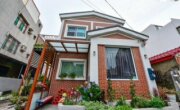
Anping X Tayouan Villa
Tayouan Villa, located in Anping, is a historic residence built in 1947 for the O family, an influential clan in the area. The old house was meticulously restored over a period of three years, with modern kitchen and bathroom facilities added while maintaining its original charm. The property preserves the essence of a 70-year-old traditional Taiwanese house, complete with a spacious front courtyard featuring a "Sun, Moon, and Qilin" wall.
The wall is adorned with a Taiwanese-themed garden, while the exterior stone walls showcase a design inspired by Tainan's iconic milkfish. The walls also feature relief tiles depicting oysters, crabs, and egrets, reflecting the unique characteristics of Anping.
The Tayouan Villa was designed by renowned carpenter "Mao Pai" Zhang Licao. This masterpiece showcases traditional craftsmanship with a unique blend of architectural styles. The property features a covered corridor leading to the main hall, accompanied by a distinctive "Bao Xia" roof structure, exclusive to Anping.
The villa spans 265 square meters and offers Chinese-style living rooms, a front courtyard garden with a water feature, a rear garden walkway, a Chinese-style pavilion, and four double rooms. This expansive space makes it an ideal retreat for guests seeking independence and solitude.
The interior design incorporates artistic elements from Pan Chunyuan, a celebrated artist from Tainan. The main hall and room doors feature couplets, calligraphy, and paintings created by the late Pan Chunyuan.
Specifically, the left wall of the main hall displays four consecutive poems written in various calligraphic styles: running script, clerical script, Wei stele, and regular script, based on Hong Zicheng's "Cai Gen Tan". The right wall showcases four literati paintings reflecting the four seasons.
Spring is represented by Su Dongpo's willow embankment, listening to the oriole; summer by Yunlinzi washing the mulberry tree; autumn by Tao Yuanming picking chrysanthemums by the eastern fence; and winter by Lin Hejings visiting the plum tree on isolated Mount Ling.