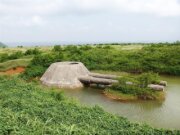
Surrounded by sea, Penghu has long had abundant fisheries. Fish-processing methods introduced during Japanese rule let fishers sell previously low-value catches on Taiwan's main island and overseas, helping the local industry grow. Fish kitchens were part of that industry and sprang up along ports and in villages. The one by Houliao's old wharf dates to around the 1960s.
Round herrings, known locally as chou rou yu, and small anchovies were among the main seasonal catches. Village women soaked and washed the fish in brine, cooked them on round bamboo trays and then dried them in the sun and wind. The dried fish was sold in Taiwan and Japan. As catches dwindled, demand changed and people moved away, the industry declined and the old kitchens fell into disuse. Older residents still remember how busy the kitchens once were.
The Baisha Township Office and the community development association restored the Houliao Shanban'an Fish Kitchen and reopened it in July 2017. The site helps older villagers recall that era and shows younger generations how fishing villages once lived. The project also aimed to connect the kitchen with nearby attractions and encourage tourism in Baisha. The site is also listed as Sanba'an Fish Kitchen.
The kitchen sits by Houliao's old wharf in Baisha, close to Paradise Road. The restoration kept its original structure. Four figures made from fishing floats and other recycled materials strike different poses and show different tasks involved in processing fish. A painted fishing boat beside the coral beach recalls the local fishing history and stands out against the sand, blue sky and white clouds.