The lighthouse stands on Yizaiwei Cape west of Wai'an, near Xiliu, one of Penghu’s six strong sea currents. It gave vessels between Xiamen and Taiwan a landmark for navigating and seeking shelter. In 1778, Taiwan prefect Jiang Yuanshu and Penghu magistrate Xie Weiqi organized construction of the Xiyu beacon. It was finished the following year. A surviving inscription describes a seven-storey granite tower, with each level seven chi high on a base five zhang across. A temple beside it enshrined Mazu, and its attendant lit the oil lamp at night. After wind damage, Penghu magistrate Jiang Yong and the naval authorities raised funds to rebuild it in 1823.
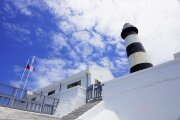
In 1873, the Qing government acquired land for a stronger light. The customs project was led by Robert Hart and designed in 1874 by British engineer David Marr Henderson. Work began on August 11, 1875, and the light was first lit on December 15. It was Taiwan and Penghu’s earliest modern Western-style lighthouse. The round cast-iron tower is 11 metres tall and tapers upward around an iron spiral staircase. Originally black, it became white after 1909, later wore camouflage and was restored to white in 1969. The cast-iron nameplate above its doorway still bears Henderson’s name and 1874. Two Fujian customs boundary stones survive by the wall. A cross outside marks the grave of Nelly O’Driscoll, the daughter of a foreign keeper.
Three fog guns once warned ships. During Japanese rule a louvered weather screen was added. In 1897 an undersea cable linked the station with Magong, an early use of wired communication in Penghu and Taiwan. The light remained in service after bombing damage in 1945. In 1966 it received an electric lamp with a fourth-order rotating lens. The recorded output at the time was 180,000 candlepower and the range 25.1 nautical miles. Two electric fog signals were added in 1981. After restoration of the national monument, the Maritime and Port Bureau announced its reopening to visitors on January 31, 2026.