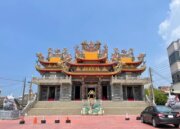
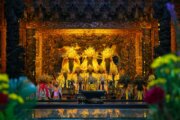
Peitian Temple in Puzi is dedicated to Mazu. Local tradition dates its origin to 1687, when Lin Ma, a resident of Dongshi, brought a statue of the goddess from Meizhou. He stopped beneath a hackberry on the south bank of the Puzi River and agreed to leave the statue for a few days so residents could worship. When he tried to leave, it was too heavy to move. The residents sought guidance using divination blocks and built a shrine beside the tree. They called it Pushu Temple, and the settlement growing around it became known as Puzijiao. The middle and worship halls were enlarged in 1715. After restoration in 1865, the site took the name Peitian, expressing a wish that the goddess would be honored for generations and share in the work of heaven and earth.
The entrance, main and rear halls follow a central axis, with wings and bell and drum towers to either side. During the 1915 rebuilding, in which Chen Yingbin took part, separate teams of artisans worked the left and right sides. Their different approaches remain visible in the timbers and carvings of the entrance hall. In 1947 the rear hall was repaired and the towers were added. The temple later built a pilgrims’ residence and rebuilt its wings. Its surviving objects include a Mazu carved from tree roots and a bronze incense burner and candleholders donated by Suantou Sugar Factory workers in 1922.
The temple’s imperial lanterns are a Lantern Festival tradition. The story goes that the Jiaqing Emperor allowed naval commander Wang Delu to arrange lanterns at home for the older brother and sister-in-law who raised him. Wang later brought the lanterns to the temple to honor Mazu and share them with the public.