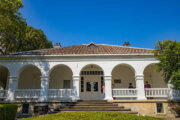
Located at the intersection of Nanhai Road and Quanzhou Street in Taipei City, this building was originally the “Taiwan Educational Association Building.” Constructed in 1931, it was primarily used to display the achievements of education in Taiwan and to host Taiwan Art Exhibitions and other art exhibitions, and was periodically used for gatherings. The architecture was designed by Sei Aromi, the chief of the Office of Public Works of the Governor-General’s Office, and thus resembles the style of the Assembly Hall, adopting a modern eclectic architectural style. Its exterior is clad with brown facing bricks, and the parapet is decorated with geometric motifs in stucco plaster. After 1945, the building briefly served as the venue for the Provincial Consultative Assembly. In 1959, it was leased by the U. S. Information Service in Taiwan. After the formal severance of diplomatic relations between Taiwan and the U.S. in 1979, it was renamed the “U.S. Cultural Center” and continued to be used until 2001. Following that, a five-year preservation and restoration project was undertaken. It officially became the “228 National Memorial Hall” on February 28, 2007, and opened for operations on February 28, 2011. This building was designated as a Taipei City designated historic site in 1993. Within the modern architectural heritage of Taipei City, it holds significant historical meaning reflecting the architectural style of the 1930s, and embodies the historical developments in modern Taiwan.
The museum consists of a permanent exhibit area for the 228 Incident, a special exhibition area, art spaces, and multi-functional performance studios, in addition to exhibitions relating to historical education. It also organizes various activities concerning democracy and human rights to introduce the 228 Incident and the progress of modern democracy while providing pathways for human rights education.