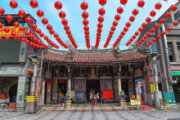
North of Lukang stands the Mazu Temple; to the south, the Ksitigarbha Temple. Together they embody the settlement’s belief that the north governs Heaven, the south governs Earth. In Lukang, faith in Ksitigarbha runs deep; during the Ghost Festival this temple’s incense is thickest, its rites most solemn. Gates kept shut all year swing open to host the Yulan Bowl ceremony, closing again only after nightfall.
The Ksitigarbha Temple faces west with its back to the east, built in the three-bay, two-courtyard style. Founded in 1663 as a tiny earthen shrine, it was rebuilt in brick in 1683 and is now 343 years old. The main deity is Ksitigarbha Bodhisattva, flanked by the Local Tutelary God, the Birth Goddess, and the Ten Kings of Hell. The plan comprises two halls and two corridors; in the main hall Ksitigarbha is enshrined, with the Local Tutelary God and the Birth Goddess in side niches.
Inside the temple are preserved a Ksitigarbha image from the Jiaqing era, the 1878 plaque “Dignity of India,” and on the right wall the 1818 stele “Record of Donations for Rebuilding the Jingyi Garden.”