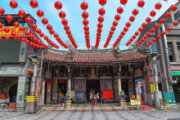
The Quanzhou temple Fengshan Temple, designated as a county-level historic site, is dedicated to Guangze Zunwang. Its original temple is Fengshan Temple in Nan’an County, Quanzhou Prefecture. Migrants from Nan’an brought incense there to Lugang for worship; after the temple was built, it too was named Fengshan Temple. Fengshan Temple was erected in the second year of the Daoguang reign (1822 CE) and expanded in the tenth year of Daoguang. Originally a long, narrow temple, it later had its central courtyard removed and its Sanchuan Hall moved backward to make way for street widening, giving it its present appearance. Today, seams can still be seen on either side of the Sanchuan Hall—visitors are invited to take a close look. Let me tell you: Guangze Zunwang, also called Bao’an Zunwang, is also known as Guo Shengwang, Guo Wanggong, Guofu Shengwang, and more; he is the deity most revered by Quanzhou people. Experts will note that the courtyard contains stele inscriptions by Jinshi Liao Chunbo and former worthy Chen Huaicheng, texts of great documentary value. The left wing once housed a Beiguan music club; today only the “Yu Ruyi” plaque remains, and inside is also enshrined Su Wangye from Wanchun Temple. The dragon-and-tiger panels in front of the Sanchuan Hall and the calligraphy-and-painting panels inside the courtyard are both made of jiaozhi pottery, brimming with antique charm; the temple is elegant in aspect and rich in cultural relics, well worth a visit. Fengshan Temple is dedicated to Guangze Zunwang; its original temple is Fengshan Temple in Nan’an County, Quanzhou Prefecture. Migrants from Nan’an brought incense there to Lugang for worship; after the temple was built, it too was named Fengshan Temple.