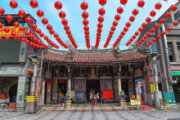
Nanjing Temple According to the “Changhua County Gazetteer,” it was erected in the 37th year of the Qianlong reign, the壬辰 year (Western calendar 1772), funded by merchants from Nanjing, Zhangzhou Prefecture, Fujian. Standing to the right of the Wangye Temple, it enshrines Lord Guan as its principal deity. (Stele preserved in Nanjing Temple.) Nanjing merchants invited the image of Lord Guan from their ancestral temple to Taiwan, first raising a shrine on the Lukang waterfront (the present site; at that time boats and rafts moored in front of the temple). Originally an exclusive center of worship for Zhangzhou immigrants, it has since become a Guandi Temple for people of every background. Nanjing Temple’s principal deity is Lord Guan (reverently styled within this temple as the Great Emperor Who Subdues Demons). Flanking guardians are Crown Prince Guan Ping and General Zhou Cang. Also venerated are the Literary Star Lord, Marshal Xie, Lord Ma, the Red Hare steed that covers a thousand li in a day, the 81-jin divine weapon the Green-Dragon Crescent-Blade, and all officers and troops. Lord Guan, personal name Yu, style name Yunchang, original style Changsheng, was a native of Xieliang in Hedong during the Three Kingdoms period. Together with Liu and Zhang he swore the Peach-Garden oath; his deeds of loyalty, filial piety, integrity, and righteousness are honored for all ages. Lord Guan is one of the Five Wenchang; in Confucianism he is venerated as the Sage Emperor of Wenheng. The chronicles say: “One man in Shandong wrote the Spring and Autumn Annals (Confucius); one man in Shanxi read them (Lord Guan).” Hence he is called both “Master Guan” and “the Shanxi Master.” Honored as a Secondary Sage and Worthy, supreme in martial skill and lofty in virtue, accomplished in both civil and military arts, scholars revere him as a god of literature and as their own guardian.