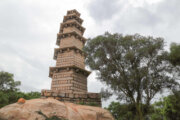
The Wentai Pagoda was built in the 20th year of the Hongwu reign (1387) during the Ming Dynasty. It was one of the three stone pagodas constructed by Zhou Dexing, a “Jiangxia Commissioner,” on Kinmen at the behest of Ming Emperor Zhu Yuanzhang, and it remains the only Ming‑era stone pagoda on Kinmen that has survived the ravages of war unscathed and without cannon damage.
Standing tall, the Wentai Pagoda also served historically as a navigational landmark for mariners. At the top of the pagoda are carved inscriptions and reliefs; beneath the eaves facing the direction of Kinmen City hangs a long stone slab etched with the characters “Kuei Xing Sheng Zhao” (「奎星聳照」). Below that, a relief depicts “Kuei Xing Kicking the Ball” (「魁星踢斗」), symbolizing a wish for a flourishing literary culture. The base of the pagoda bears the handwritten inscription “Wentai Pagoda” (「文臺寶塔」) by Ming‑era military officer Chen Hui (陳煇), as well as the ink work “The Nation’s Golden Pond” (「國之金湯」) by the late master of ink‑painting Zhang Daqian (張大千). These elements hold great historical significance and the site has been designated a national historic monument.