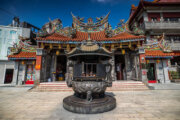
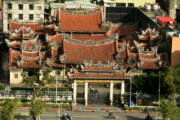
Tamsui Fuyou Temple stands on Tamsui Old Street, historically called Huwei Street. It was a centre of worship for port merchants and migrants who had crossed the sea, and is one of Tamsui’s four major temples. Some accounts put its beginnings in the Yongzheng reign, others in the Qianlong reign. The surviving temple dates back to 1796, the first year of the Jiaqing reign. It is known locally as the Mazu Temple and also enshrines Guanyin and the Water Immortal Kings. A couplet at the front evokes Meizhou and the sea crossing, expressing early migrants’ hopes for a safe passage. The temple was designated a historic monument in 1985 and is now protected by New Taipei City.
A plaque inscribed “翌天昭佑” hangs in the main hall. Local tradition says Mazu aided the defenders during the 1884 Battle of Huwei in the Sino-French War. In 1886, after Governor Liu Mingchuan petitioned the court, the Guangxu Emperor bestowed the plaque. The 1796 Wanggaolou stele, set into a wall of the front hall, records the lookout tower that guided boats at the mouth of the Tamsui River. The temple also preserves Qing-era plaques, including one inscribed “Heavenly Holy Mother” in 1797.
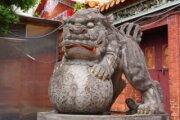
The main hall has octagonal dragon columns carved from local Guanyin stone. Behind the front hall is a Fujian-style pavilion used for worship and performances. Its brick reliefs depict pine, bamboo, deer and cranes as symbols of prosperity and longevity. Some reliefs around the temple were funded by local merchants as devotional offerings. The polished heads of the stone lions at the entrance show where visitors have touched them over the years. Local lore links the lions with the ballast once carried on boats, and people touch their heads to wish for safe passage and peace.