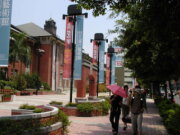
The National Museum of History stands beside the lotus pond at Taipei Botanical Garden. On December 4, 1955, Education Minister Chang Chi-yun founded the National Museum of Historical Artifacts and Fine Arts as part of the Nanhai cultural district and appointed Pao Tsun-peng as its first director. It was the first national museum newly established after the government moved to Taiwan. It opened to the public on March 12, 1956, and took its current name on October 10, 1957.
The first building was a Japanese wooden hall used by the colonial government to display commercial products. New exhibition rooms and galleries followed from 1958. A National Gallery for painting and calligraphy was built in 1961, and work on the entrance and exhibition hall began in 1962. A 1971 decision to rebuild the original wooden structure helped shape the present palace-style building with red walls and green roof tiles. The museum reopened in 2024 after restoration and adaptive reuse.
The museum began without a collection. In 1956 the Ministry of Education transferred two founding groups of objects, antiquities returned by Japan after World War II and pieces formerly held by the Henan Museum. Government transfers, private donations, purchases, and excavated finds expanded the collection. Chinese, Fujianese, and Taiwanese artifacts and modern art include prehistoric painted pottery, pre-Qin cord-marked ceramics, Shang and Zhou oracle bones and bronzes, Han green-glazed pottery, Six Dynasties dancer and musician figures, Tang sancai ceramics, stone Buddhist sculptures, jade, porcelain, early republican furniture and puppets, paintings, calligraphy, and documents.
The National Gallery was an important venue for Taiwanese artists. The museum hosted exhibitions of ancient civilizations and overseas collections and developed cross-strait exhibitions from the late 1980s, including the Terracotta Army. Regional exhibitions and tours were followed in 2001 by a mobile museum that brought displays and education to remote communities in converted container trucks. After transferring to the Ministry of Culture in 2012, the museum used collection imagery in stamps, public art, and design collaborations. It received a distinction in the fifth Government Service Quality Awards in 2013.