Bangka, now Wanhua, is one of Taipei’s oldest districts. In 1738, settlers from Jinjiang, Nan’an and Hui’an in Quanzhou pooled funds to build Lungshan Temple. They brought the worship of Guanyin from Anhai Lungshan Temple in Jinjiang. Completed in 1740, the temple became a center of worship and a place for local deliberation and appeals for divine judgment. Its deities also include Mazu, Wenchang, Guan Yu and the Old Man Under the Moon, reflecting local traditions that bring together Confucian, Buddhist and Taoist worship.
The temple was repaired after an earthquake in 1815 and a storm in 1867. Its records say that during the 1884 Sino-French War, local volunteers used the temple’s seal to contact officials. The Guangxu Emperor later bestowed a commemorative plaque. Most of the present layout dates from a rebuilding begun in 1920 at the initiative of Abbot Fuzhi and led by Quanzhou master builder Wang Yishun. An air raid destroyed the central hall in 1945. According to the temple, its Guanyin statue survived. The hall was rebuilt to its former scale and completed in 1959. The Ministry of Culture designated the temple a national monument in 2018.
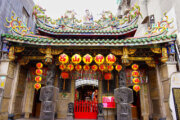
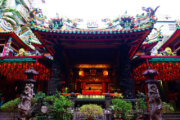
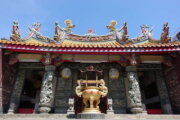
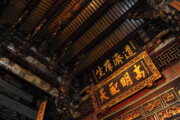
The south-facing complex has three halls and side wings arranged around courtyards. Cast bronze dragons wrap around pillars at the entrance hall. Stone panels tell stories from Romance of the Three Kingdoms and Investiture of the Gods. The main hall has a spiral coffered ceiling of interlocking wooden brackets assembled without iron nails. A covered gallery and carved calligraphy surround it. The bell and drum towers have palanquin-shaped roofs, and the roof ridges and eaves display dragons, phoenixes and qilin in cut ceramic and cochin pottery.
The temple’s recurring observances include lantern displays in the first lunar month, the Buddha Bathing Festival in the fourth, and the Ullambana rites in the seventh. They bear witness, alongside the architecture and its carvings, to religious life in Bangka.